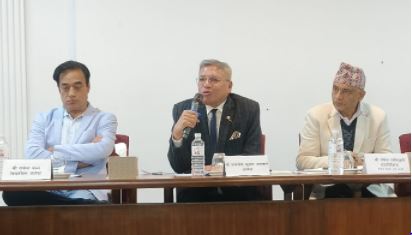


Kathmandu: An interaction program with industrialists and businesspersons regarding the operation of the National Economic Census 2082 was held on Tuesday at the Chamber Secretariat. The program was jointly organized by the Nepal Chamber of Commerce and the National Statistics Office.
Participants emphasized that close collaboration between government bodies and the private sector is essential to make the census effective and reliable.
Speaking at the program, Chamber President Kamlesh Kumar Agrawal stated that the National Economic Census would present a realistic picture of the country’s economic condition, the current status of industries and businesses, investment trends, and employment realities. He mentioned that such data would make policy formulation, laws, planning, and implementation processes evidence-based, thereby contributing positively to long-term economic development. He also clarified that the census cannot be successful without active participation from the private sector and expressed the Chamber’s readiness for necessary coordination and cooperation.
On the occasion, Director Dr. Bed Prasad Dhakal from the National Statistics Office delivered a presentation highlighting the necessity, objectives, and multidimensional importance of the census. According to him, the data obtained from the census would assist the government in policy formulation and planning, strengthen estimates of Gross Domestic Product (GDP) and national accounts, provide essential data for changing the base year, and help develop sampling frameworks for various economic surveys.
It was also expressed that the census would be useful in establishing a statistical business register system, preparing indicators of the informal economy, and gradually bringing the nearly 50 percent informal economy into the formal sector. The data would also provide a strong basis for integrating unregistered firms into the mainstream economy.
Furthermore, he informed that the census aims to collect detailed information related to industrial, commercial, and service sectors to support evidence-based policymaking. He assured that the confidentiality of collected data would be fully protected and clarified that the information would not be used as legal evidence in court. He urged businesspersons to provide necessary information without hesitation.
During the interaction, stakeholders shared their views on the effectiveness of the census, private sector participation, potential challenges during implementation, and possible improvement measures. The participants concluded that coordinated efforts from all stakeholders are necessary for sustainable economic policy formulation through reliable data.
Nepal conducted its first National Economic Census in 2075 B.S., which covered economic establishments under 18 groups according to the International Standard Industrial Classification. The office has announced that the second National Economic Census 2082 will be conducted from Baisakh 2 to Asar 7, 2082 (Nepali calendar).